


Membership Benefits - The RFPG Library

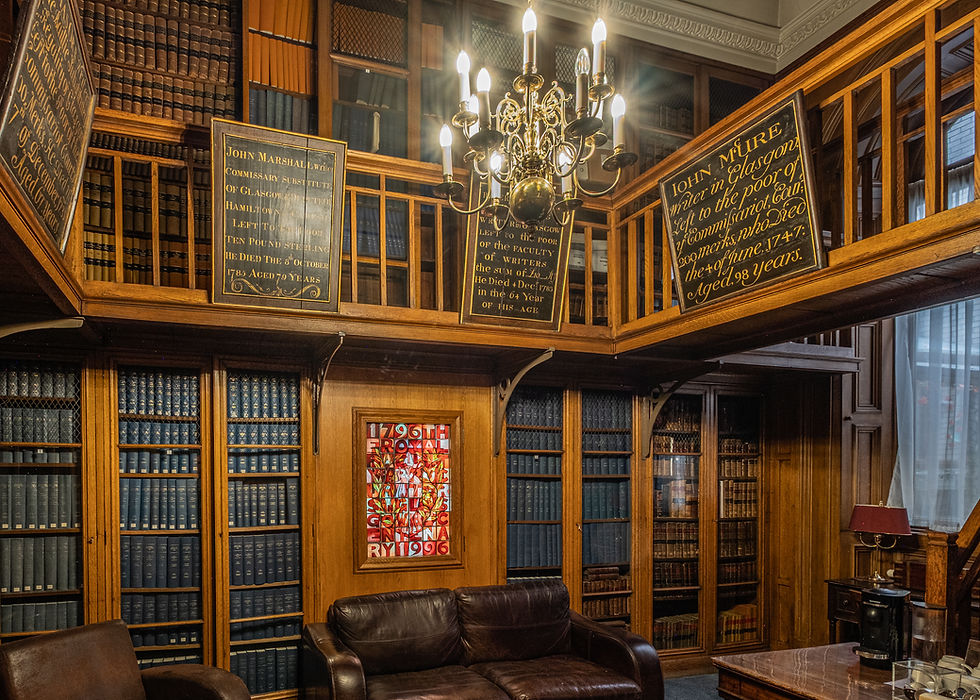
The RFPG library is regarded as the “jewel in the crown” by members for the access it gives them to an extensive collection of legal works – far beyond the means of all but the largest law firms.
Even in the case of firms with significant libraries of their own, the Faculty library provides a vital back-up when books inevitably disappear or online services fail. As well as complementing their own resources, the service offers access to historical material such as older case reports and superseded texts.
The library - financed directly by money raised from the payment of annual subscriptions - has played a central role in the life of the legal profession in Glasgow since it was first established in 1817, having first being proposed more than 80 years earlier.

While online legal resources have become indispensable to modern practice, they are most effective when complemented by the resources and expertise of a well-stocked law library. Not all legal materials are available electronically, particularly older works, historical case reports, local legislation, and specialist texts.
A comprehensive law library provides access to authoritative print sources, preserves the legal record, and enables practitioners to verify and contextualise legal developments over time. The breadth of the Faculty's collection also allows members to consult materials which may not be available through the online subscriptions held by their own firms.
The library collection now covers all areas of Scots law. We currently take every Scots law text and multiple copies of popular texts as well as significant holdings of English and European law. The library also houses comprehensive holdings of statutory materials, including local legislation, and an extensive collection of case report series.
This includes Scottish, English and European case report series and selected series from other jurisdictions, as well as journals. This has been augmented by a wide range of electronic resources.
The library remains highly relevant to members' needs, reflecting the principle that the strongest legal research draws upon both digital and traditional library resources rather than treating them as alternatives. Effective legal research depends not only on access to information but also on the ability to identify, evaluate and apply the most relevant sources.
Library staff continue to play an important role in assisting members with research enquiries, guiding them through increasingly complex information environments and helping them locate materials that may not be readily discoverable through online searching alone. This expertise is particularly valuable when practitioners are dealing with unfamiliar areas of law, historical matters or specialist sources. A law library provides depth, permanence, access to unique and authoritative materials, and specialist support that digital platforms alone cannot replicate.
While the nature of a local Faculty means that there is a definite bias towards hard copy over electronic holdings, in recent years we have been looking to improve the coverage of electronic resources as increasingly the membership comes to expect and require this and more information is made available on electronic platforms. This often necessitates the duplication of resources in different formats and reflects the Faculty’s view that digital and print resources are complementary rather than competing services.

One of the challenges constantly facing the library is catering for the needs of a diverse membership - small practices requiring more general texts while larger firms often look to the Royal Faculty for more esoteric works. Coupled with this is the fact that the membership covers the full range of legal specialisms and so the library is required to hold material on as broad a range of legal topics as possible.
The library, in addition to having a wealth of legal materials, also has significant collections of historical, biographical, antiquarian and general literature and has been the recipient of a number of bequests over the years. The most significant of these was the Hill Collection, a collection relating chiefly to Glasgow history; comprising maps, charters, illustrations and over 1,600 volumes. Since 1952 there has also been a small branch library at the Glasgow Sheriff Court which contains a collection of works used in court practice, intended for the use of members appearing before the Sheriffs there.
Membership is open to all practising and retired solicitors, law firms and Advocates. With many law firms experiencing economic pressures in recent years and budgets inevitably being squeezed, it may be tempting to review library subscriptions. Mindful of this, the Royal Faculty has worked hard to keep subscription costs for members as low as possible while ensuring that neither the quality of the library collection nor the standard of service is compromised. This has been achieved by utilising income generated from other activities, such as its highly regarded CPD education programme and auditor services, to subsidise the library.
Faculty membership offers a range of additional benefits, including belonging to a collegiate body that plays a leading role in fostering debate on issues affecting the legal profession. It represents members' interests, providing auditor services for executry and court feeing work, and offering members free access to the CPD programme. The library, though, remains the cornerstone of the Royal Faculty's activities and the service most closely associated with its historic role and continuing relevance.


Comments